
For HVAC professionals in Corpus Christi, understanding what Corpus Christi HVAC techs need to know about EPA AIM Act regulations is essential. The American Innovation and Manufacturing (AIM) Act has ushered in sweeping federal mandates, reshaping refrigerant use, leak management, compliance deadlines, and contractor responsibilities. Whether you’re part of a local team or working with one of the best HVAC contractors in Corpus Christi, Texas like Justice Inc. HVAC Contractor, this guide lays out the breakdown of the AIM Act, its impact on South Texas HVAC businesses, compliance deadlines, and what contractors should prepare for.
Breakdown of the EPA’s American Innovation and Manufacturing (AIM) Act
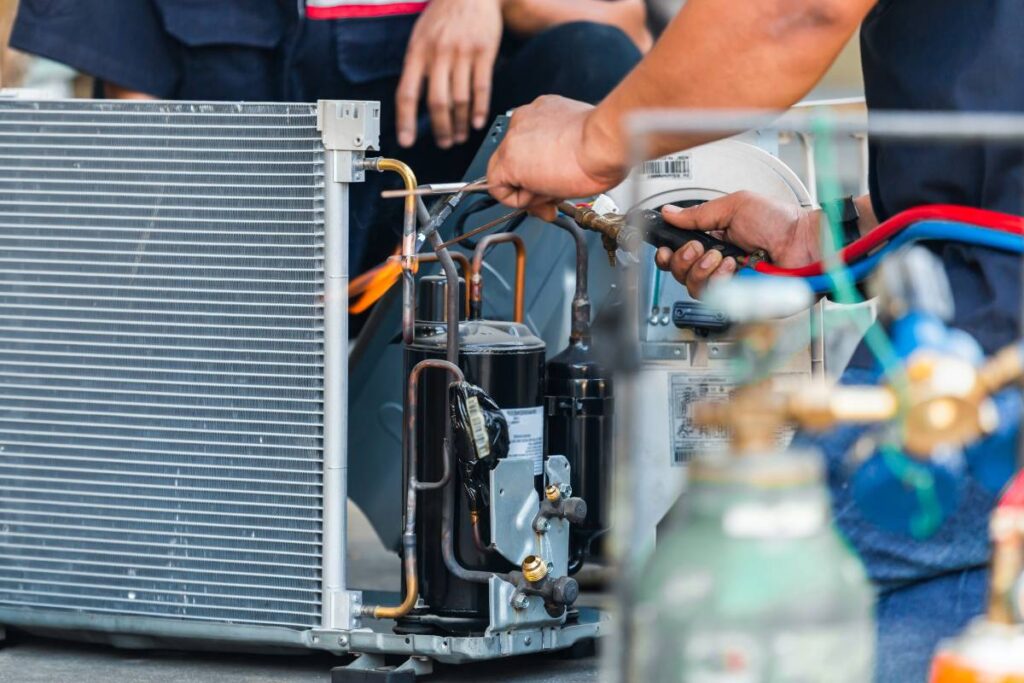
The EPA’s American Innovation and Manufacturing (AIM) Act empowers the EPA to phase down hydrofluorocarbon (HFC) refrigerants—potent greenhouse gases. The law mandates an 85 % reduction in HFC production and consumption by 2036 compared to baseline levels.
Key provisions:
- Phasedown schedule: 10 % cut in 2022, 40 % by January 1, 2024; by January 1, 2025, entirely banning use of refrigerants with GWP ≥ 700 in new HVAC equipment.
- High‑GWP Limit: As of January 1, 2025, new systems must use refrigerants under GWP 700—e.g. R‑32 (GWP ~675), R‑454B (~466).
- Leak detection & repair rules: For systems charged with 15+ lbs of refrigerant (GWP > 53), leak inspection and repair deadlines tighten; large systems (≥1,500 lbs) must install automatic leak detection (ALD) systems by January 2026.
- Reclaimed refrigerant requirement: From January 1, 2028, technicians must use reclaimed refrigerant when servicing HFC systems.
- Disposable cylinder rules: Cylinder refill/import ban starts July 1, 2025, and complete ban from 2026.
- Enhanced recordkeeping: Detailed tracking of assets, leak history, repair logs, and invoice documentation for EPA audits.
Impact on HVAC Businesses in South Texas
For HVAC companies in Corpus Christi and the broader South Texas region, these federal mandates bring multiple operational and strategic shifts. Here’s what Corpus Christi HVAC businesses—and particularly the standout local provider Justice Inc. HVAC Contractor—must keep in mind.
Refrigerant sourcing and pricing
R‑410A, widely used in local homes and light commercial systems, is now phased out for new equipment starting in 2025. Existing systems can still be serviced, but refrigerant costs are projected to rise sharply as production allowances shrink.
Technician training and certification
Handling flammable A2L refrigerants such as R‑32 and R‑454B requires updated EPA‑Section 608 training and safety certification. Teams at Justice Inc. HVAC Contractor and other Corpus Christi specialists need to be fully compliant to remain competitive and safe.
Leak management and equipment upgrades
Systems with larger refrigerant charges are now subject to routine inspections, quicker repair timelines, and potentially mandatory ALDs. Corpus Christi businesses must plan for these requirements to avoid penalties and minimize downtime.
Operational and reputational risk
Non‑compliance carries serious consequences. EPA civil fines can reach up to $60,000 per day per violation—some sources cite even up to $100,000/day if treated under earlier Clean Air Act enforcement. Systems out of service for violation remediation can damage client trust in communities across South Texas.
Compliance Deadlines and What Contractors Should Prepare For

Here are the key milestones and action items HVAC professionals in Corpus Christi need on their calendar:
🔧 Key Compliance Deadlines
| Date | Milestone |
| Jan 1, 2025 | Ban on manufacture/import/sale of HVAC systems using refrigerants GWP ≥ 700 (e.g. R-410A) |
| Jul 1, 2025 | Refillable disposable HFC cylinders prohibited; must use reclamation services |
| Jan 1, 2026 | Full enforcement of leak detection, repair timelines, asset tracking; ALDs required for systems ≥1,500 lb |
| Jan 1, 2028 | Requirement to use reclaimed refrigerants for servicing HFC systems |
✅ Preparation Checklist for Corpus Christi HVAC Contractors
- Inventory audit: Tag and document all equipment containing refrigerants, noting GWP, charge weight, system location, and service history.
- Upgrade equipment: For new installations or replacements, switch to systems using low‑GWP refrigerants approved under the AIM Act.
- Install leak detection: Evaluate systems close to or over 15 lbs GWP > 53; large installations (≥1,500 lbs) must include ALD systems.
- Train and certify staff: Ensure techs are certified under EPA Section 608 universal certification and safe handling of flammable refrigerants.
- Implement compliance tools: Partner with software or management platforms that automate record‑keeping and reporting for audits.
- Plan for cylinder disposal: Set up relationships with reclaimers for cylinder heel removal in advance of the July 2025 ban.
Why This Matters – Especially for Justice Inc. HVAC Contractor

As one of the best HVAC contractors in Corpus Christi, Justice Inc. HVAC Contractor has a reputation for staying at the forefront of industry standards. By proactively adapting to the AIM Act’s phasedown schedule, Justice Inc. ensures they:
- Provide compliant, low‑GWP system installations.
- Avoid supply chain shocks and refrigerant scarcity.
- Minimize financial and regulatory risk through robust compliance systems.
- Deliver high‑quality, environmentally responsible service to South Texas clients.
Clients across Corpus Christi look to Justice Inc. HVAC Contractor as trusted partners in HVAC care—especially as federal rules tighten and consumers demand greener, safer systems.
Conclusion
What Corpus Christi HVAC techs need to know about EPA AIM Act regulations is clear: the law mandates a phase‑down of high‑GWP refrigerants, enforces strict leak detection and reporting, and imposes real deadlines on sourcing, equipment, and service practices. Contractors in South Texas—particularly leaders like Justice Inc. HVAC Contractor—must lean into advanced training, system tracking, and low‑GWP transitions to stay compliant and competitive.
With January 1, 2025 and January 1, 2026 fast approaching for key regulation triggers, Corpus Christi HVAC businesses must act now: audit equipment, train technicians, secure compliant refrigerants, implement leak detection, and embrace robust record‑keeping.
By doing so, HVAC professionals in Corpus Christi not only meet federal mandates but position themselves as sustainability champions, trusted contractors, and industry leaders in the era of the EPA AIM Act.

Another quality article by Justice Inc. Home and Commercial Services team.
Call (361) 888-8881 for fast and reliable service!

